Portfolio Case Study
Improving Retention Through Structured Onboarding
Early attrition was high during the first 60 days, creating staffing instability and higher replacement costs. New hires felt overwhelmed and underprepared, so onboarding needed to reduce early-stage pressure without lowering performance standards.
New hires were entering production before confidence and support were stable.
Early attrition was roughly 28%, and the first 60 days were the highest-risk period. New hires were moving into production with low confidence, limited support, and performance expectations that escalated faster than their readiness, increasing staffing instability and replacement costs.
- The transition from training to production was too abrupt.
- Early performance expectations increased faster than readiness.
- Nesting did not provide enough structured support.
- Repeated early failure weakened confidence during the most fragile stage.
A more stable transition into early production.
- Structured onboarding and decision-support tools reduced reliance on SMEs and team leads during early production.
- Gradual exposure, the QA glidepath, and real-time support reduced performance volatility during nesting.
- New hires experienced a clearer transition into production instead of a sudden jump into full accountability.
- Early performance independence increased and transition-to-production variability decreased.
How onboarding was redesigned to protect early retention
The redesign reduced early-stage pressure without lowering standards. It built confidence through visible progression, more manageable exposure, and support that continued from training into live production.
- 01
QA Glidepath
QA expectations increased progressively, making early performance standards clearer and reducing the shock of moving directly into full accountability.
- 02
Progressive Exposure
Task complexity and production pressure were introduced gradually so new hires could build capability without becoming overwhelmed.
- 03
Coaching & Feedback
Daily coaching and frequent feedback created opportunities to correct issues early and recover from mistakes before they became repeated failures.
- 04
Performance Support
Real-time tools reduced dependence on memory and gave agents practical support while handling live work.
- 05
Manager Enablement
Managers were equipped to coach against specific skill gaps and intervene more consistently when new hires were struggling.
Evidence from the solution design
Open an artifact to review the complete framework or full-size support tool.
Daily Coaching Framework
Observe, coach, and reinforce through daily checkpoints that reduce volatility early in production.
ObserveCoachReinforce
Daily checkpoints and coaching guidance designed to stabilize early-production performance.
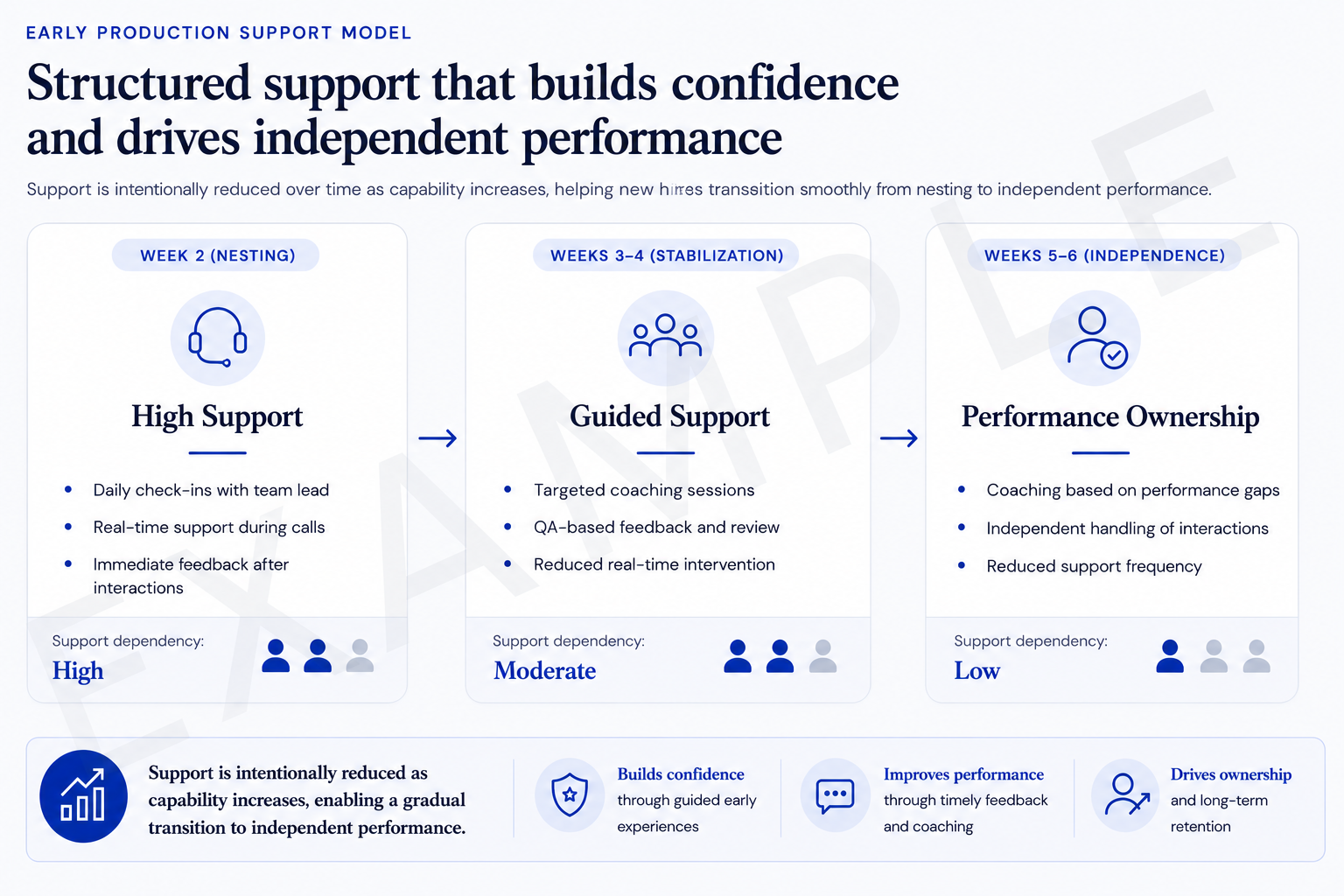 Support Model
Early Production Support Model
Support Model
Early Production Support Model
A staged model that reduces intervention as confidence and performance stabilize.
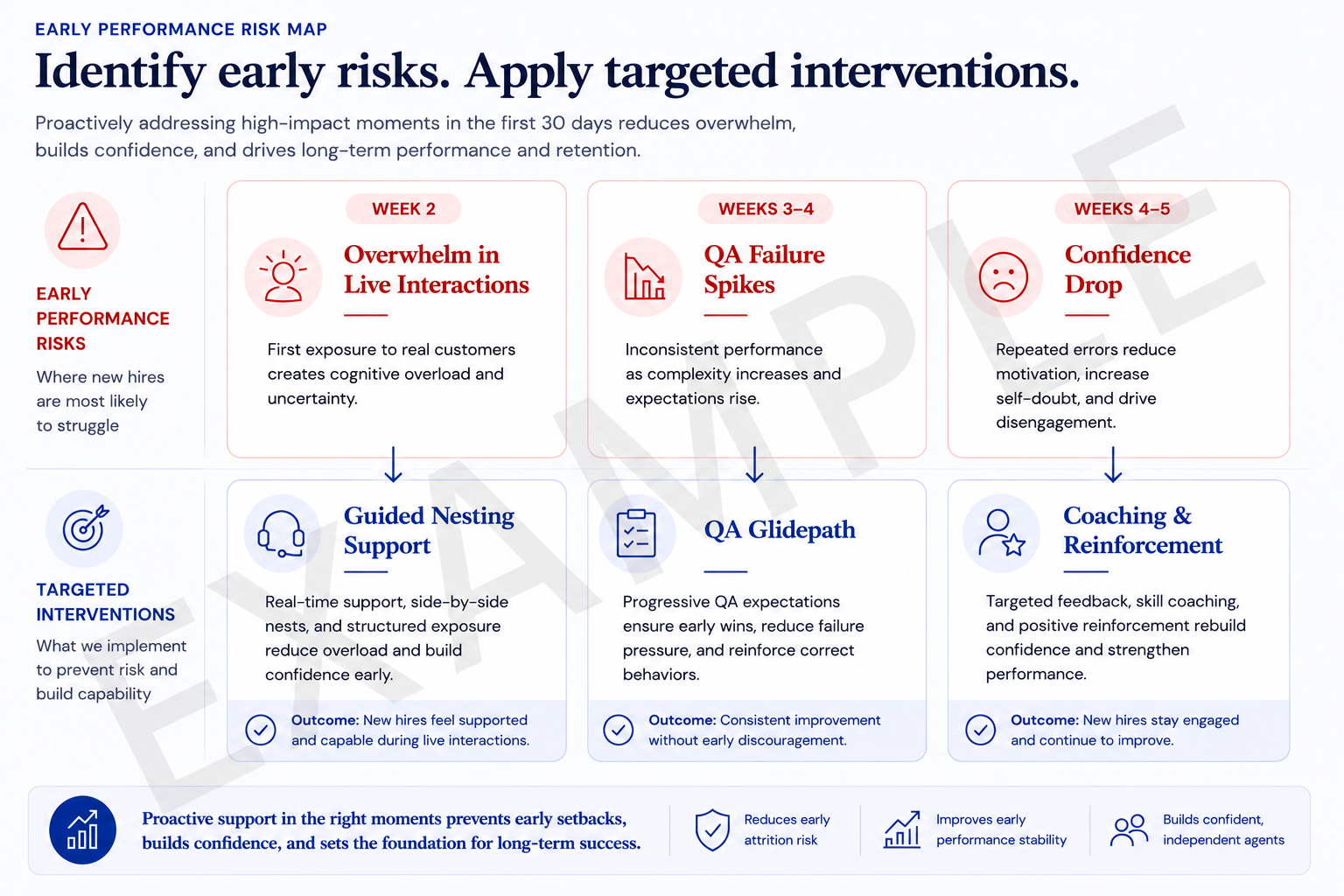 Decision Tool
Early Performance Risk Map
Decision Tool
Early Performance Risk Map
Targeted interventions for high-risk moments before they become disengagement or attrition.
Example 1 Details
Hide details
Daily Coaching Framework
This coaching framework shows how team leads can reinforce confidence, correct issues quickly, and reduce early-stage performance volatility during nesting and early production.
Framework Goal
Stabilize performance before pressure peaks
A simple daily coaching rhythm designed to help new hires become independent faster while protecting quality in PCI-sensitive interactions.
Observe
Spot friction early.
Coach
Correct one behavior at a time.
Reinforce
Build confidence through repetition.
Pre-Shift Readiness
- Confirm the day's call focus and expected QA target
- Review one high-risk scenario or recent repeat error
- Set one confidence-building goal for the shift
Mid-Shift Observation
- Listen for hesitation, escalation patterns, or policy confusion
- Track whether support dependency is increasing or decreasing
- Use one targeted correction instead of broad feedback
Post-Shift Debrief
- Review one success, one risk, and one next-step action
- Reconnect feedback to the QA glidepath stage
- Log whether the learner is moving toward independent handling
Structured onboarding can protect retention without lowering performance standards.
This project demonstrates how visible progression, realistic support, and continued coaching can build confidence during the period when new hires are most vulnerable. Retention and performance do not have to compete when early success is supported without removing clear standards.
Next Step
Need something similar for your team?
Whether you need onboarding support, process documentation, digital learning, or a workshop, I can help turn complex knowledge into something clear and usable.