Portfolio Case Study
Enabling PCI Compliance from Day 1
New customer support agents needed to handle PCI-sensitive payment and account-verification interactions early in production. Onboarding had to prepare them for high-risk decisions and protect compliance without unnecessarily slowing readiness.
Compliance knowledge was not translating reliably into production behavior.
Agents encountered sensitive payment and verification scenarios early in production, before they had enough guided practice. Compliance mistakes affected more than quality scores: they created QA failures, escalations, and operational risk.
- Compliance was treated as theoretical knowledge rather than observable performance behavior.
- Agents had limited practice with realistic, high-risk payment and verification scenarios.
- Structured reinforcement did not extend far enough into early production.
- Training, compliance, and QA expectations were not consistently aligned.
Compliance readiness improved without slowing proficiency.
- Agents reached expected QA levels by Weeks 3–4.
- Critical compliance failures decreased during early production.
- Onboarding and QA expectations became more consistently aligned.
- PCI readiness improved without delaying progression to full proficiency around Weeks 6–7.
How compliance was embedded into onboarding
Compliance shifted from passive information toward applied decision-making. The redesigned experience gave agents realistic practice before live exposure and reinforced the required behaviors during early production.
- 01
Scenario Simulations
Realistic PCI-sensitive payment and account-verification scenarios were introduced before production so agents could rehearse high-risk decisions safely.
- 02
Decision Flows
Compliance checkpoints and required behaviors were embedded directly into decision paths, making the correct action more visible in sensitive interactions.
- 03
Critical-Failure Rules
Zero-tolerance expectations clarified which actions created the greatest compliance and business risk and established a more consistent performance standard.
- 04
QA Alignment
Onboarding and QA expectations were connected through a clearer glidepath from supported learning into accountable production.
- 05
Reinforcement Tools
Job aids and coaching extended compliance support into early production, helping agents apply required behaviors under real customer pressure.
Evidence from the solution design
Open either artifact to review the complete experience or full-size tool.
A branching scenario for practicing compliance checkpoints, realistic judgment, and safer responses under pressure.
Open interactive artifact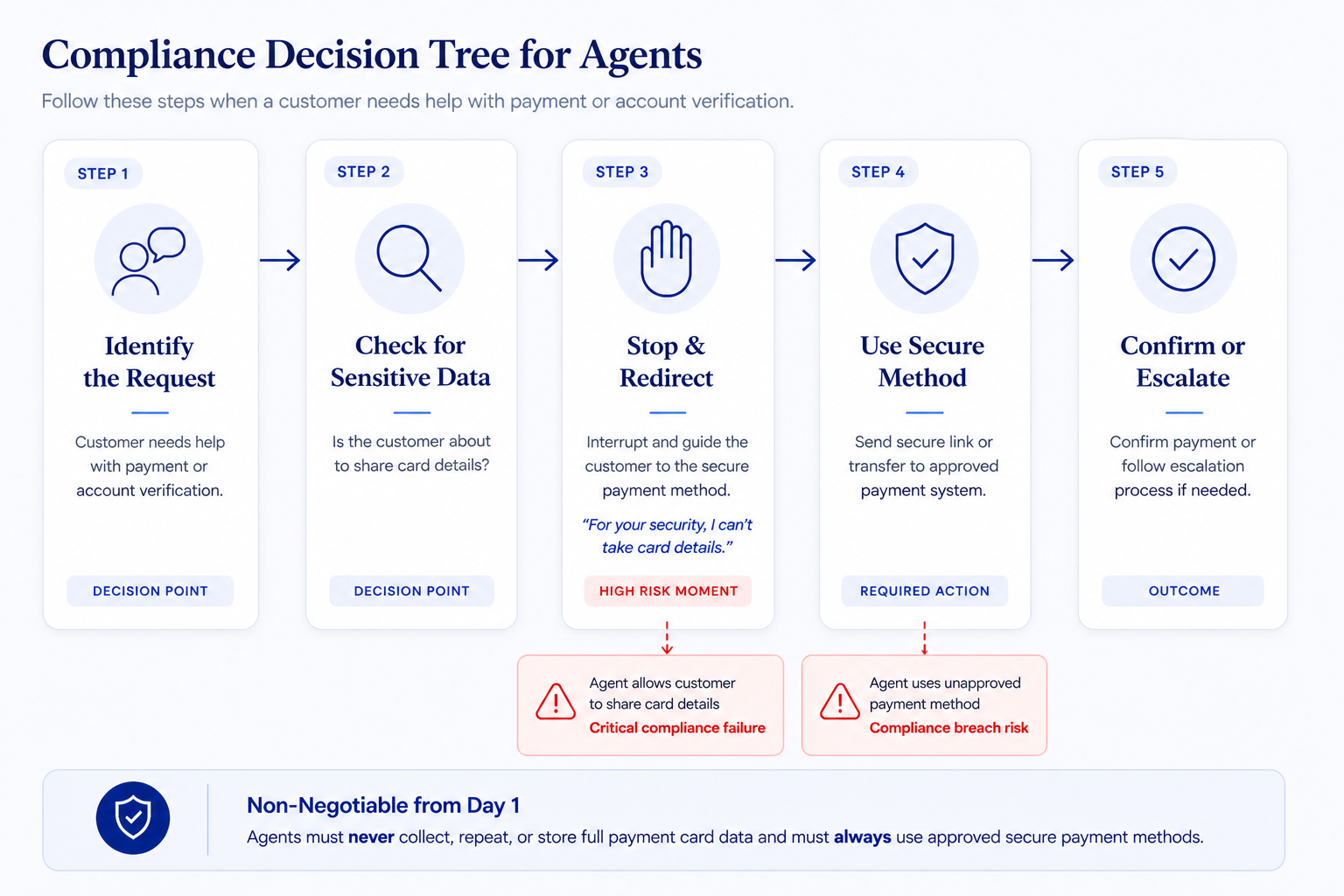 Decision Tool
Compliance Decision Tree
Decision Tool
Compliance Decision Tree
A visual decision-support tool guiding secure actions during payment and account-verification scenarios.
Open full-size artifactCompliance learning became part of operational performance.
This project demonstrates how realistic rehearsal, decision support, and continued reinforcement can make compliance part of day-to-day performance rather than detached theory. Aligning learning, QA, and operational expectations supported stronger PCI readiness without unnecessarily slowing the broader path to proficiency.
Next Step
Need something similar for your team?
Whether you need onboarding support, process documentation, digital learning, or a workshop, I can help turn complex knowledge into something clear and usable.